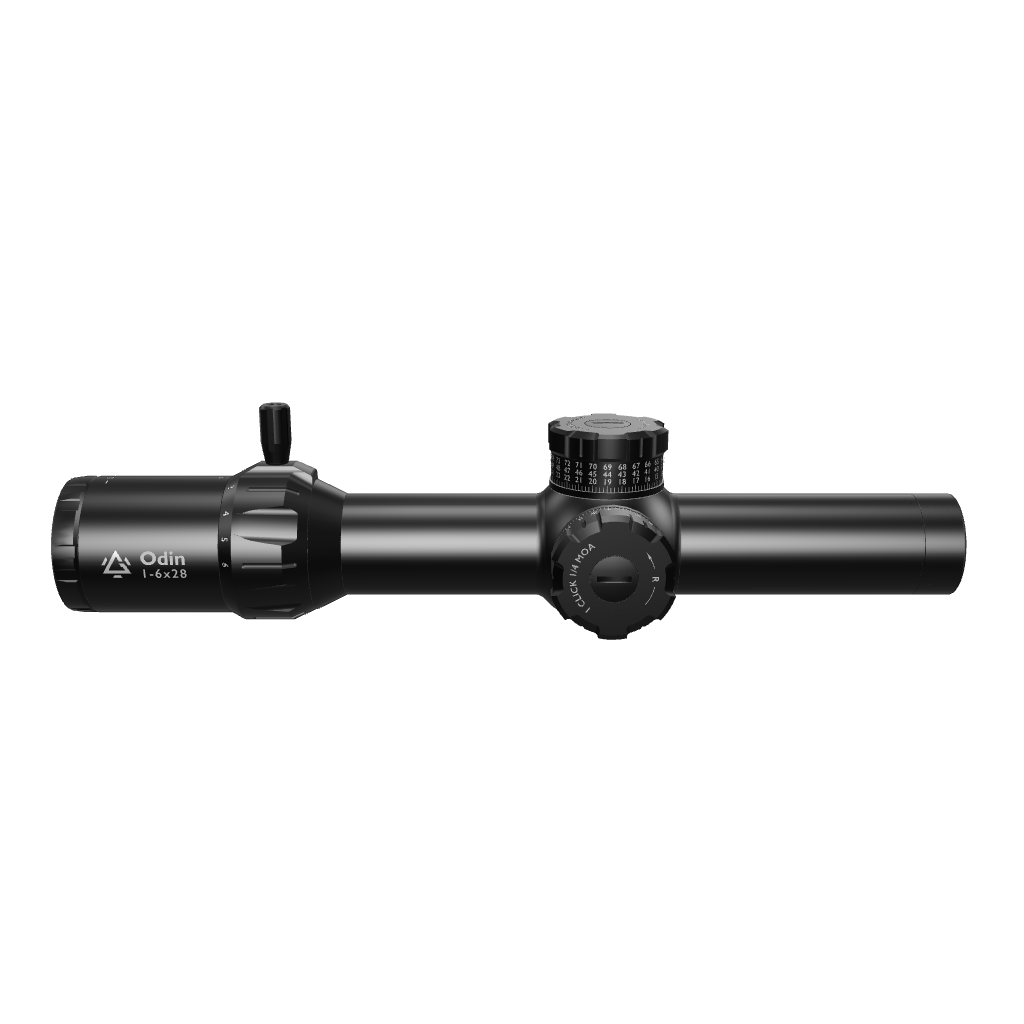

Rifle Scope Sighting-in Distances Explained

Every shooter needs to know how to sight in a rifle scope for consistent precision and peace of mind. The distance you choose for your initial zero changes how your bullet travels at long ranges.
Sighting In Distance Chart: 25-200 Yards
| Sighting-in Distance | Ideal Scenario | Best For |
| 200 yards | Shooting or hunting in open areas where longer distances are common | Flat-shooting rifles, AR-15 platforms, long-range or open-field hunting |
| 100 yards | Regular use at standard gun ranges and use of calibrated reticles | Scopes with BDC reticles, general-purpose rifles |
| 50 yards | Wanting a consistent point of aim at close to moderate distances | Shooters who prefer minimal adjustments and simple zeroing |
| 25 yards | Mostly indoor shooting or short-range use | .22 LR rifles, small game hunting, pistol-caliber carbines for home defense |
1. Sighting in at 200 Yards: When to, and How to Do It
Many experienced shooters prefer a 200-yard zero distance for their primary rifles. This distance is excellent for flat-shooting cartridges that need to reach out further, as it allows you to stay on target at various ranges without constantly adjusting your turrets.
Choose 200 yards as your zeroing distance if you hunt in open fields or shoot at longer ranges: it provides a versatile trajectory that works well for many modern sporting purposes like the AR-15 platform.
Even a small wobble at the bench creates a massive miss at this distance, so you should follow these data points to understand the 200-yard zero trajectory:
- A 5.56 NATO round will often be about 1.5 inches high at 100 yards.
- The bullet will cross the line of sight again exactly at the 200-yard mark.
- You will likely see a drop of around 7 to 9 inches at 300 yards.
- This zero keeps your shots within a 2-inch vital zone from 50 to 225 yards.
Tips for Sighting-in at 100 Yards
Sighting in a rifle scope at 200 yards requires a steady rest and a clear range, so you want to ensure your rifle is completely stable before you start your groups.
Start by getting your hits centered at a closer distance first to save your ammo. Many people use a 50-yard target to get on the paper before moving back, and once you are hitting the bullseye at 200 yards, your rifle is ready for the field.
2. Sighting in at 100 Yards: When to, and How to Do It
Knowing how to sight in a rifle scope for 100 yards is a fundamental skill for every gun owner. The 100-yard zero is arguably the most common choice for shooters across the globe, and it’s no doubt the gold standard for precision because it removes many variables from the equation.
You should opt for this distance if you spend most of your time at a standard gun range, and it’s also the ideal choice if your rifle scope has a ballistic drop compensating reticle. Most of those reticles are designed specifically to start their calculations from a 100-yard base.
Check out these common trajectory points for a 100-yard zero:
- Your point of impact will be exactly the same as your point of aim at 100 yards.
- Most standard calibers will sit about 1.5 inches low at 200 yards.
- You can expect a drop of roughly 12 to 15 inches when reaching out to 300 yards.
- This zero is the most accurate way to measure the raw groups your rifle can produce.
Tips for Sighting-in at 100 Yards
- Place your target out at the century mark and use a solid lead sled or sandbags.
- Fire a three-shot group to see where the rifle is currently grouping on the paper.
- Adjust your elevation and windage turrets.
- Once your group sits right in the center of the red, you’re all set.
3. Sighting in at 50 Yards: When to, and How to Do It
The 50-yard zero offers a very flat trajectory that works perfectly for home defense or close-quarters training. This distance is often called the improved combat zero because of its versatility at practical ranges.
You should use this distance if you want your point of aim to stay consistent out to moderate ranges. It is particularly effective for shooters who do not want to worry about large height adjustments.
Understanding how to sight in a rifle scope at 50 yards is a great way to simplify your shooting. You do not need a massive outdoor range to get your rifle ready for action. Many indoor ranges offer exactly this distance, making it very accessible for city dwellers and suburban shooters.
Consider these trajectory facts for the 50-yard zero:
- Your bullet will be at the exact point of aim at the 50-yard line.
- The bullet will typically strike the center again at the 200-yard mark.
- You will be about 1 to 2 inches high at the 100-yard distance.
- This provides a very usable point of impact from 25 yards out to 250 yards.
Tips for Sighting-in at 100 Yards
Set your target at 50 yards and ensure your optic is mounted securely to the rail. Fire a slow and steady group to see where the rounds are impacting the target board. Once you are centered, you will have a rifle that is effective for almost any common encounter.

4. Sighting in at 25 Yards: When to, and How to Do It
The 25-yard zero is most common for rimfire rifles or when you are just starting with a new centerfire build. It is the best starting point for getting a new optic onto a large piece of paper.
You should choose this as your permanent zero if you primarily use a 22 LR for small game hunting or you’re mostly indoors. It is also a very smart choice for pistol caliber carbines that you use for home defense. What’s best is that, at this range, you don’t have to worry about wind or significant bullet drop during your session.
Learning how to sight in a rifle scope at 25 yards is the first step for many new gun owners. It allows you to see your hits clearly without the need for expensive binoculars or a spotting scope.
Keep these data points in mind for a 25-yard zero:
- Your bullet will cross the line of sight for the first time at 25 yards.
- For many high-velocity rounds, the bullet may hit high at 100 yards.
- A 25-yard zero can sometimes result in a second zero at 300 yards.
- This is the easiest way to confirm that your optic is mounted level.
How Do You Decide What Distance to Sight in Your Scope
Choosing a zero depends entirely on your specific rifle and your intended purpose. A hunter in thick woods needs a different setup than a long-range target shooter.
Your choice of optic also dictates the best sighting distance for your needs, as an LPVO is often best with a 100-yard or 200-yard zero for maximum versatility. Red dots are popular at shorter distances because they are built for speed and close encounters.
Additionally, ballistics play a huge role in this decision because every caliber performs differently. A flat shooting round like the 5.56 NATO behaves differently than a heavier .308 Winchester, so you’d want to pick a distance that minimizes how much you have to think about holdovers.
Either way, consider the following factors when making your final decision:
- The primary caliber and barrel length of your rifle.
- The typical environment where you will be shooting or hunting.
- The maximum distance you feel comfortable shooting accurately.
- The type of reticle inside your rifle scope.
Most modern shooters use a rifle scope sighting distance chart to see where their bullet lands at various ranges, which helps them visualize the trajectory before they ever pull the trigger. You want a zero that keeps your bullet within a small kill zone for as long as possible.
Final Thoughts
Choosing the right distance for your zero is the best way to master how to sight in a rifle scope. Whether you prefer the precision of a 100-yard mark or the versatility of a 50-yard zero, consistency is your best friend. Take your time at the range and use a stable rest for the best results.
You might also be interested in these simple steps to zero your LPVO.