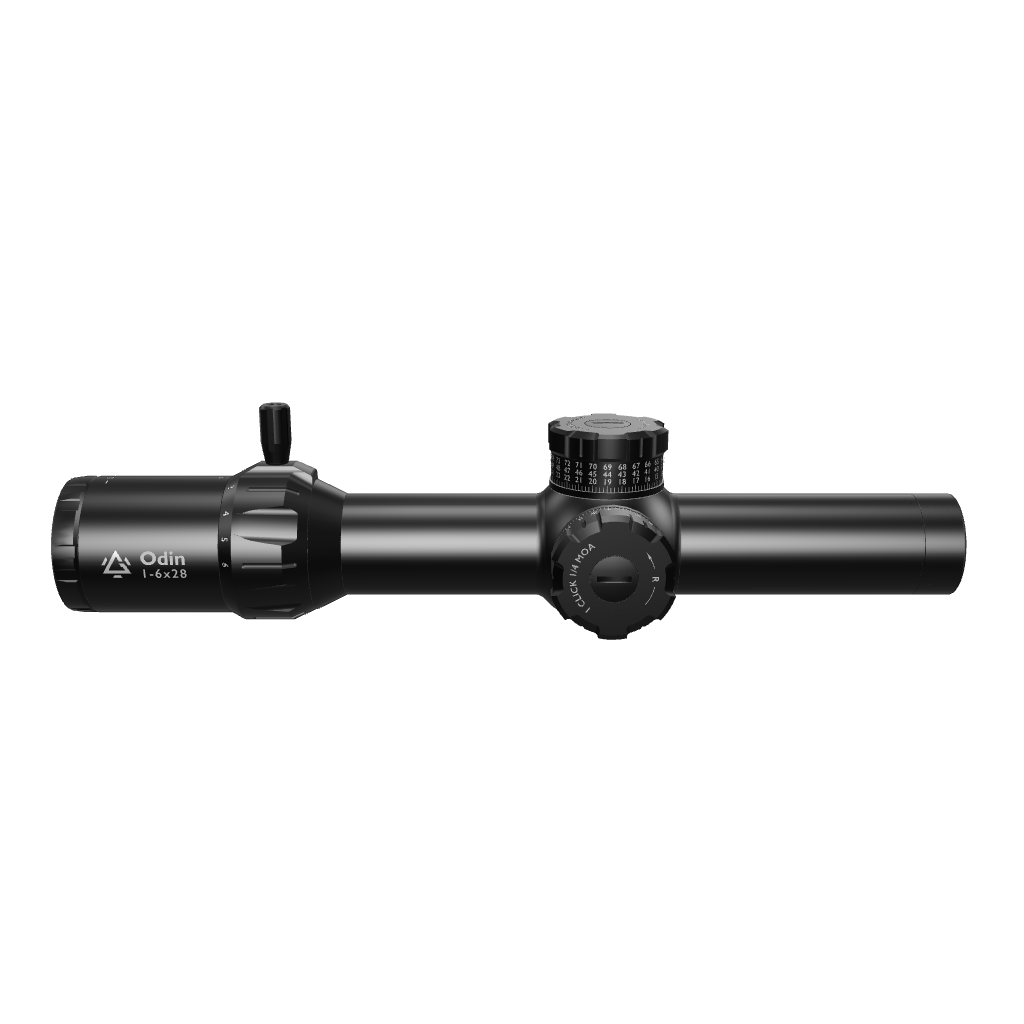

Spotting Scope Magnification Explained: How Much Zoom Do You Need?

Whether you are glassing a distant mountainside for a big game or trying to read bullet holes on a target at a long-distance range, your optics will make or break your experience. Choosing the best magnification for spotting scope use depends entirely on your environment, your target, and how far away you are standing.
Spotting Scope Magnification Explained
At its core, magnification is the measure of how much larger an object appears through an optic compared to the naked eye. If a spotting scope has a magnification of 20x, the target will appear 20 times closer than it actually is.
When you look at a spotting scope, you will usually see a set of numbers like 20-60x80.
The first two numbers (20-60x) represent the spotting scope magnification range. This means the image can be zoomed from 20 times closer than the naked eye up to 60 times closer. The final number (80) is the diameter of the objective lens in millimeters, which dictates how much light enters the scope.
While a high magnification spotting scope sounds ideal on paper, higher zoom shrinks your field of view (the width of the area you can see) and intensifies atmospheric distortion, like heat waves or "mirage."
What Magnification is Best for Spotting Scope Use?
For general use, the best spotting scope magnification falls into the 20-60x zoom range. This gives you a highly adaptable magnification spotting scope view: you can use the lower 20x setting to quickly find your target with a wider view, and then zoom in to 60x to inspect finer details.
However, your ideal power changes depending on your specific distance:
-
Spotting scope magnification for 200 yards to 300 yards: If you are shooting or observing at closer ranges, a lighter option like a 25x magnification spotting scope (such as a compact entry-level unit like a sharper image 25x magnification spotting scope) is plenty of power. A lower what magnification spotting scope for 200 yards requirement means you can get away with smaller, highly portable glass.
-
Spotting scope magnification for 1000 yards: At extreme long distances, you need premium optics. The best spotting scope magnification for 1000 yards requires a robust 60x or 80x top end. At this distance, the quality of the glass matters much more than just the raw numbers.
Balancing the Highest Magnification Spotting Scope Options
It is tempting to simply shop for the highest magnification spotting scope or a specialty spotting scope with the highest magnification eyepiece reaching 100x or more.
However, a quick spotting scope magnification comparison reveals a harsh reality: at extreme magnification levels, daylight mirage and environmental dust will blur your image. If the air is boiling with heat waves, a cheap scope zoomed to 60x will actually show you less detail than a high-quality scope set to a crisp 30x.
Best Spotting Scope Magnification for Birding
When it comes to bird watching, your requirements change drastically compared to target shooting or big-game hunting. Birds are small, fast, highly detailed, and frequently hide in shadows or dense foliage.
The best spotting scope magnification for birding typically lands in the 20-60x or 15-45x range. However, the ideal configuration depends heavily on where you do most of your birding.
Why 20-60x is the Industry Standard for Birding
A 20-60x variable zoom lens gives you the ultimate flexibility required for field identification.
-
The 20x Scan: You will spend most of your time at the lower end. A lower magnification provides a wider field of view and a brighter image, which is vital for tracking a moving bird or finding a small songbird hidden in branches.
-
The 60x Detail Zoom: Once you locate the bird, dial up the magnification to observe fine plumage details, leg bands, or beak shapes. This is especially critical for identifying tricky species like shorebirds, raptors, or gulls.
When to Choose 15-45x
If you actively hike long distances, bird in dense forests, or frequently travel, a compact 15-45x magnification scope with a 50mm or 65mm objective lens may be a better fit.
-
Lighter Weight: These scopes are significantly shorter and lighter, making them easier to carry on a harness or a lightweight tripod.
-
Sharper Low-End Images: Because you rarely push past 40x zoom, the image stays razor-sharp and resists the dark, muddy look that cheap 60x scopes suffer from in low-light environments.
Glass Quality Matters More Than Raw Magnification
In birding, color fidelity and image resolution are everything. A faint ring around an eye or a subtle color variation on a wing feather can be the difference between identifying a rare vagrant or a common backyard resident.
The Golden Rule of Birding Optics: A premium, optically sharp 30x fixed eyepiece or high-end 15-45x zoom with ED (Extra-low Dispersion) glass will reveal far more detail than a cheap 20-60x scope. High-magnification is useless if chromatic aberration (color fringing) blurs the edges of your target.
Tips for Choosing a Birding Scope
-
Angled vs. Straight: Most birders prefer an angled body design (where the eyepiece points up at a 45-degree angle). This makes it much easier to look upward at birds in trees or overhead in flight, and allows birders of different heights to share the same tripod setup easily.
-
Objective Lens Size: Pair your magnification with a 65mm lens for portability and daytime clarity, or an 80mm–85mm lens if you regularly bird at dusk, dawn, or across dark mudflats.
Best Spotting Scope Magnification for Hunting
When you are packing into the backcountry, every ounce in your pack must earn its keep. Choosing the best spotting scope magnification for hunting is a balancing act between having enough power to judge a trophy animal at long range and keeping your gear light enough to carry up a mountain.
For the vast majority of hunters, the ideal magnification range is 20-60x or a slightly more compact 15-45x.
Tracking vs. Judging: How Hunters Use Magnification
Hunters don't use spotting scopes the same way they use binoculars. Binoculars are for finding animals; a spotting scope is for evaluating them.
-
15x to 20x (The Locator): This lower range offers a wider field of view and a brighter image. It is perfect for scanning a distant basin or ridge line to see if those tiny specs are a herd of elk or just a patch of light colored rocks.
-
45x to 60x (The Trophy Judge): Once you spot the game, you dial up the magnification. At this range, you can determine if a bull elk meets legal antler point restrictions, count the curls on a bighorn ram, or check the age class of a buck before committing to a grueling miles-long stalk.
Choosing Your Hunter Archetype
Because hunting environments vary wildly, your ideal scope setup depends on your specific hunting style:
|
Hunting Style |
Recommended Magnification |
Ideal Objective Lens |
Why This Combo Works |
|
Backcountry / Western Wilderness |
15-45x or Compact 20-60x |
50mm - 65mm |
Saves weight and pack space during long-distance foot travel without sacrificing critical high-end detail. |
|
Truck / Beanfield / Whitetail Stand |
20-60x or 25-50x Wide |
80mm - 85mm |
Weight doesn't matter if you aren't hiking far. The massive front glass maximizes light gathering at dawn and dusk. |
The Hunter's Hidden Enemy: Heat Mirage
It is incredibly common for hunters to assume that buying the highest magnification possible is the best strategy. However, open valleys and mountain faces bake under the sun, creating heavy atmospheric heat waves (mirage).
During midday heat, a high-magnification scope dialed to 60x will often yield a blurry, boiling image. In these conditions, you will actually see a sharper, more defined animal by backing your zoom down to a crisp 30x or 40x.
FAQ
What magnification is best for a spotting scope?
For most users, a 20-60x variable zoom scope is the standard sweet spot. It offers a low enough magnification for a wide field of view and high enough power to see details at long distances.
What does 20-60x80 mean on a spotting scope?
The 20-60x refers to the adjustable magnification range (20 times to 60 times closer than the naked eye). The 80 represents the 80mm front objective lens, which controls light gathering and image brightness.
How far can you see with a 20-60x60 spotting scope?
You can easily see large objects like mountains or elk several miles away. However, for reading small targets like bullet holes on paper, a 20-60x60 scope is generally effective out to about 300–400 yards in clear conditions.
What magnification spotting scope for 1000 yards?
You will want a scope that reaches at least 60x to 80x magnification. More importantly, you need premium HD or ED glass to resolve fine details through the heavy atmospheric distortion present across a half-mile of open air.
What is the difference between 20-60x60 and 20-60x80 spotting scope?
Both have the exact same zoom power, but the 20-60x80 has a larger front lens. The 80mm lens gathers significantly more light, providing a brighter, clearer image in low-light environments like dawn or dusk.
Is 20x enough for 1000 yards?
A 20x view is enough to see large structures, steel targets, or vehicles at 1000 yards. However, 20x is definitely not enough power to see bullet holes on paper or accurately evaluate game animals at that extreme distance.