
Best LPVO for Your Money: Gunnr LPVO Under $500

Finding the perfect Low Power Variable Optic (LPVO) used to mean choosing between draining your savings account or settling for blurry glass that can’t hold a zero. Thankfully, those days are over.
Gunnr has completely disrupted the budget-to-mid-tier market with their Odin ED series. Every single scope in this lineup features German Schott ED glass (extra-low dispersion glass that prevents color fringing and maximizes clarity), First Focal Plane (FFP) reticles, and robust 7075 aluminum alloy construction.
If you are looking for the absolute best bang-for-your-buck LPVO, here is how the Gunnr Odin lineup shakes down to help you pick the perfect glass for your rig.
Best Gunnr LPVO for Your Money
|
Product |
Image |
Best For |
Review Score |
Price |
Direct Store Link |
|
Gunnr Odin 1-6×28 FFP |
 |
🏆 Best Value for Close-to-Medium Range Transitions |
⭐ 5.0/5 (21 reviews) |
$319.99 |
|
|
Gunnr Odin 1-8×24 FFP |
|
🏆 Best Versatile All-Rounder for Hunting & Tactical Use |
⭐ 4.5/5 (7 reviews) |
$289.99 |
|
|
Gunnr Odin 1-10×28 FFP |
|
🏆 Best Maximum-Range Precision LPVO |
⭐ 5.0/5 (7 reviews) |
$339.99 |
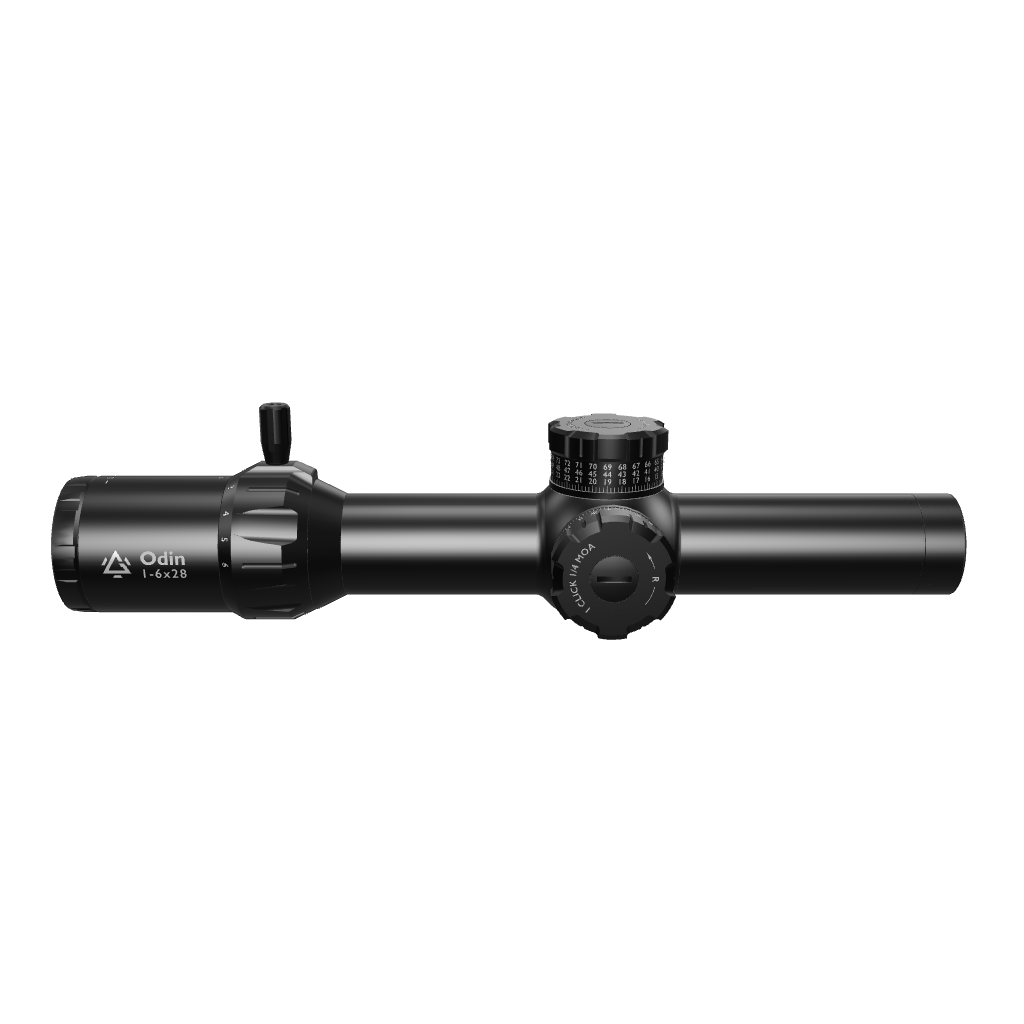
1. Gunnr Odin ED 1-6×28 FFP LPVO
🏆 Best Value for Close-to-Medium Range Transitions
If you want an incredibly forgiving eye box and a wide field of view for rapid target acquisition, the Odin 1-6x28 is the sweet spot. Built on a beefy 34mm tube, it lets in an impressive amount of light, giving you edge-to-edge sharpness that punches way above its price class. With a flawless 5/5 score from users, this is a crowd favorite for a reason.
-
Reticle: GRX-2B MOA (Red Illuminated, 6 levels)
-
Tube Size: 34mm
-
Weight: 685g
-
Eye Relief: 3.74 in.
Why it’s worth the money: The 28mm objective lens gives you a slightly larger exit pupil at maximum magnification compared to standard 24mm rifle scopes. This translates to an incredibly bright, fast sight picture when transitioning between targets under pressure.
2. Gunnr Odin ED 1-8×24 FFP LPVO
🏆 Best Versatile All-Rounder for Hunting & Tactical Use
Need a little more reach without packing on extra bulk? The Odin 1-8x24 stretches your effective distance out comfortably while shrinking down to a 30mm tube profile. It's lighter than the 1-6x model (666g vs 685g) and features a highly requested, tactile Zero-Stop function so you can dial your elevation out far and snap right back to your baseline instantly.
-
Reticle: GRX-2B MOA (Red Illuminated, 6 levels)
-
Tube Size: 30mm
-
Weight: 666g
-
Eye Relief: 3.6 in.
Why it’s worth the money: This is the "goldilocks" scope of the group. It is shorter and lighter than the 1-6x, gives you 2x extra magnification on the high end, and introduces the Zero-Stop feature—making it a perfect companion from dawn-to-dusk hunting to competitive tactical matches.
3. Gunnr Odin ED 1-10×28 FFP LPVO
🏆 Best Maximum-Range Precision LPVO
For shooters demanding cutting-edge variable power, the Odin 1-10x28 pushes the absolute limits of what an LPVO can do. Gunnr managed to squeeze a massive 1-10x magnification range into a compact 10.98-inch chassis. Paired with a 34mm tube and a 28mm objective lens to keep the exit pupil usable at 10x, this optic is designed for shooters who want true 1x red-dot speed up close but need to reliably identify and engage targets hundreds of yards out.
-
Reticle: GRX-2B MOA (Red Illuminated, 6 levels)
-
Tube Size: 34mm
-
Weight: 666g
-
Eye Relief: 3.6 in.
Why it’s worth the money: Maintaining crystal-clear resolution at 10x magnification requires elite glass. Thanks to the German Schott ED lenses and the FFP reticle layout, your MOA holdovers remain perfectly accurate whether you're dialed to 1x or zoomed all the way to 10x. It delivers high-end tier performance without the premium tier markup.
Technical Comparison At-A-Glance
|
Feature |
Odin 1-6x28 FFP |
Odin 1-8x24 FFP |
Odin 1-10x28 FFP |
|
Tube Diameter |
34mm |
30mm |
34mm |
|
Length |
11.7 in. |
11.1 in. |
10.98 in. |
|
Weight |
685g |
666g |
666g |
|
Eye Relief |
3.74 in. |
3.6 in. |
3.6 in. |
|
Zero-Stop |
No |
Yes |
Yes |
|
Weatherproofing |
IP67 Waterproof |
IP67 Waterproof |
IP67 Waterproof |
Which One Should You Buy?
-
Go with the Odin 1-6x28 if you prioritize a massive eye box, rapid close-quarters shooting, and maximum light transmission.
-
Choose the Odin 1-8x24 if you want the ultimate lightweight, balanced setup with an intuitive Zero-Stop system for diverse environments.
-
Step up to the Odin 1-10x28 if you want maximum power flexibility to push your rifle to its absolute distance limits without changing optics.
How to Choose LPVO? Beginner’s Guide
Choosing an LPVO (Low Power Variable Optic) can feel overwhelming with all the numbers and acronyms thrown around. To pick the right one, you just need to break it down into four simple decisions based on how you actually plan to shoot.
1. Pick Your Magnification Range
LPVOs are defined by their zoom range (e.g., 1-6x, 1-8x, 1-10x). The right one for you depends entirely on your target distance.
-
1-6x Power: Best for speed and close-to-medium range (0 to 400 yards). These generally have the most forgiving eye box (the physical space behind the scope where your eye can actually see a clear picture) and a very bright 1x setting, making them feel almost as fast as a standard red dot sight up close.
-
1-8x Power: The sweet spot for all-around flexibility (0 to 600 yards). It gives you extra reaching power for positive target identification at distance without adding significant weight over a 1-6x.
-
1-10x Power: Best for maximum distance precision (0 to 800+ yards). Perfect if you routinely shoot out far or need to spot tiny targets. However, keep in mind that at 10x, the eye box becomes very tight, requiring perfect, consistent head placement.
What is the Best LPVO? (1-6x, 1-8x, or 1-10x)
2. First Focal Plane (FFP) vs. Second Focal Plane (SFP)
This determines how the reticle behaves when you zoom in.
First Focal Plane (FFP): The reticle grows and shrinks as you change magnification. Because the reticle scales with the image, your holdover lines (subtensions) are perfectly accurate at any magnification setting. This is highly preferred for tactical shooting and changing distances quickly.
Second Focal Plane (SFP): The reticle stays the exact same size no matter how much you zoom. This means your holdover marks are only accurate at one specific magnification setting (usually the maximum power). SFPs are great if you just want a bold, easy-to-see reticle at 1x, but they require extra math if you want to use holdovers at partial zoom.
FFPS VS SFPS: KEY DIFFERENCES EXPLAINED
3. Tube Diameter: 30mm vs. 34mm
The main tube diameter impacts two things: light transmission and adjustment range.
-
30mm Tubes: Lighter and slimmer. There are massive amounts of mounting options available. Perfect for saving weight on a hunting or general-purpose rifle.
-
34mm Tubes: Thicker and slightly heavier, but they allow for a wider internal range of elevation and windage adjustments. They also handle light transmission beautifully, especially when paired with a larger objective lens (like a 28mm), resulting in a brighter image at higher magnification.
4. Key Features to Look For
Before you hand over your cash, make sure the scope checks these three boxes:
-
Quality Glass: Look for terms like ED glass (Extra-low Dispersion). High-end glass ensures that when you zoom all the way into 8x or 10x, the image stays sharp and clear instead of turning into a blurry, dark mess.
-
Daylight Bright Illumination: A great LPVO can act like a red dot at 1x power, but only if the illuminated center is bright enough to see in direct, harsh sunlight.
-
Zero-Stop Function: If you plan on clicking your turrets to adjust for distant shots rather than just using holdover lines, a Zero-Stop lets you mechanically lock your baseline zero. You can dial out as far as you want, and then snap back to zero without counting clicks or accidentally getting lost a full rotation off.