
M16 With LPVO: Why It Works

On paper, it does seem like a mismatch: a traditionally longer, rifle-length platform paired with an optic that is more modern and designed for versatility. But in practice, pairing your M16 with an LPVO can be an extremely effective combination that performs spectacularly in certain scenarios.
The key is understanding what each component brings to the table and how they complement each other, and to be open to seeing how that can be a good combo in certain shooting scenarios.

LPVO on M16: Why it's Actually Not a Bad Idea
The purpose and design of an LPVO line up surprisingly well with what an M16 platform is capable of.
At its core, an LPVO is designed to bridge the gap between two things: speed at close quarters and precision at mid-range. Hence, it naturally complements the versatility of an M16 while offering a practical advantage: magnification.
Here are four reasons to consider an M16 with an LPVO setup.
1. It Matches the M16’s Strength: Range and Stability
With its longer barrel and rifle-length gas system, the M16 platform tends to offer better velocity (especially when you compare it to other shorter carbines), smoother recoil impulse, and improved accuracy at distance.
An LPVO takes advantage of that by giving you magnification when you need it, without sacrificing close-range usability. The 1x keeps the rifle usable at close range, while the 6x–8x takes advantage of the M16’s accuracy and velocity.
2. True 1x Magnification for Close Range
At 1x, a good LPVO behaves almost like a red dot, and this means your M16 isn’t limited to distance shooting; you can still use it effectively, even at close range.
With an LPVO, you get both-eyes-open shooting, fast target acquisition, and minimal distortion at close range.
3. On-Demand Magnification for Distance
When you dial up to 4x, 6x, or even 8x, target identification becomes easier, your shot placement improves, and you can fully utilize the rifle’s ballistic potential. This flexibility is what makes the LPVO such a natural fit. Instead of committing to one role, your rifle adapts to the situation.
4. Better Target Identification
One often overlooked benefit: magnification isn’t just about hitting targets, it’s about identifying them correctly. That matters in any scenario where clarity and decision-making are important.

Best Uses and Applications of an M16 With LPVO
The set combo of an LPVO with an M16 really shines in scenarios where you need versatility. The most practical use cases are in mid-range shooting scenarios, general-purpose rifle setups, training, and general outdoor/ outfield use.
1. Mid-Range Shooting (100–500 Yards)
The M16 platform excels at these distances, and the LPVO gives you the magnification needed for precise shot placement. Definitely worth considering if you are a recreational shooter, target shooter, or anyone focused on accuracy beyond typical carbine distances.
2. General-Purpose Rifle Setup
With 1x for close range and magnification for distance, this setup covers a wide range of scenarios without needing multiple optics. Consider it if you are looking for a “do-it-all” rifle setup rather than something highly specialized.
3. Training and Skill Development
An LPVO forces you to think about magnification, positioning, and transitions between distances. It’s a more dynamic shooting experience.
Shooters who want to build well-rounded skills instead of relying on a single shooting style.
4. Outdoor and Field Use
Open environments often require both awareness and precision. The LPVO allows you to scan at low magnification and engage at higher magnification when needed.
Shooters operating in open terrain or variable environments.
Best LPVOs for M16
Not all LPVOs are created equal, and the right choice for any rifle depends on how you plan to use the rifle. For an M16 platform, the sweet spot is usually 1–6x LPVO and a 1-8x LPVO.
1. 1-6x LPVOs for M16
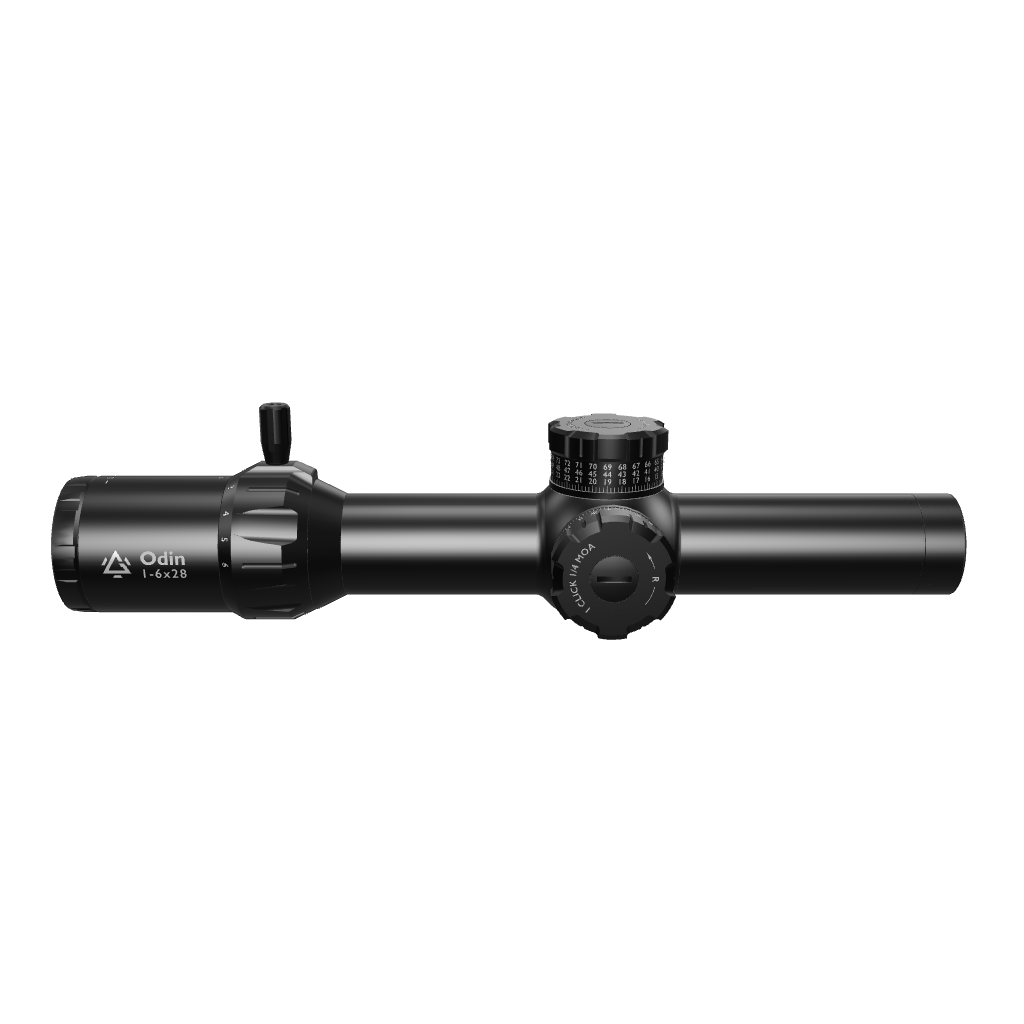
If you’re prioritizing simplicity and weight, go for a 1–6x LPVO. 1-6x LPVOs are typically lighter, and paired with an M16, you'd get incredible flexibility and fast target acquisition at a lower range.
The Odin 1-6x LPVO features a first focal plane (FFP) reticle that provides fast, accurate distance estimation at any magnification, adapting seamlessly to changing light conditions with six brightness settings. It's also constructed from durable 7075 aluminum alloy and IP67-rated for dust and waterproof performance.
2. 1-8x LPVO for M16
If you want more reach and flexibility, a 1–8x LPVO is a better fit for an M16. This is the best all-around option, and it is better for extended range and target identification.
The Odin 1-8x LPVO features the superior clarity of German Schott ED Glass, ensuring exceptional edge-to-edge sharpness for every shot. It also has an FFP (First Focal Plane) reticle that grows and shrinks alongside the magnification, ensuring your holdovers and subtensions remain accurate at any zoom level.
It is ideal for precise long-range shooting without the need for constant adjustments, and ideal for making the most out of your M16.

M16 With an LPVO: Setbacks and Considerations
As good as an M16 with LPVO is, this combination is obviously not perfect. There are trade-offs, like the increased weight, that you need to be aware of.
- You have to deal with the added weight: LPVOs are heavier than red dots or fixed optics. On an already longer M16 platform, this can increase fatigue during extended use and affect your handling speed.
- It is slower than a red dot at close range: Even with a true 1x setting, an LPVO has more eye relief constraints and requires more precise head positioning. This makes it slightly slower in very close, fast-paced scenarios.
- It can be costly: Quality LPVOs tend to be more expensive than basic optics. If you want clear glass, reliable tracking, or durable construction, you’ll likely be paying a premium.
There can be a steep learning curve: Using an LPVO effectively means knowing when to adjust magnification, managing transitions between distances, and understanding your reticle. It’s not difficult, but it does take practice.
Final Thoughts on M16 With LPVOs
An M16 with an LPVO works because it plays to the strengths of both components. The rifle offers stability and range, while the optic adds flexibility and adaptability.
It’s not the lightest or fastest setup for every situation, but if you want a rifle that can handle close-range engagement and stretch out to mid-range distances with confidence, it’s hard to beat.
Like most gear choices, it comes down to your priorities. But if versatility is high on your list, this combination makes a lot of sense. Explore more on 1-6x vs 1-8x LPVOs, for more context on these options that are available to you.