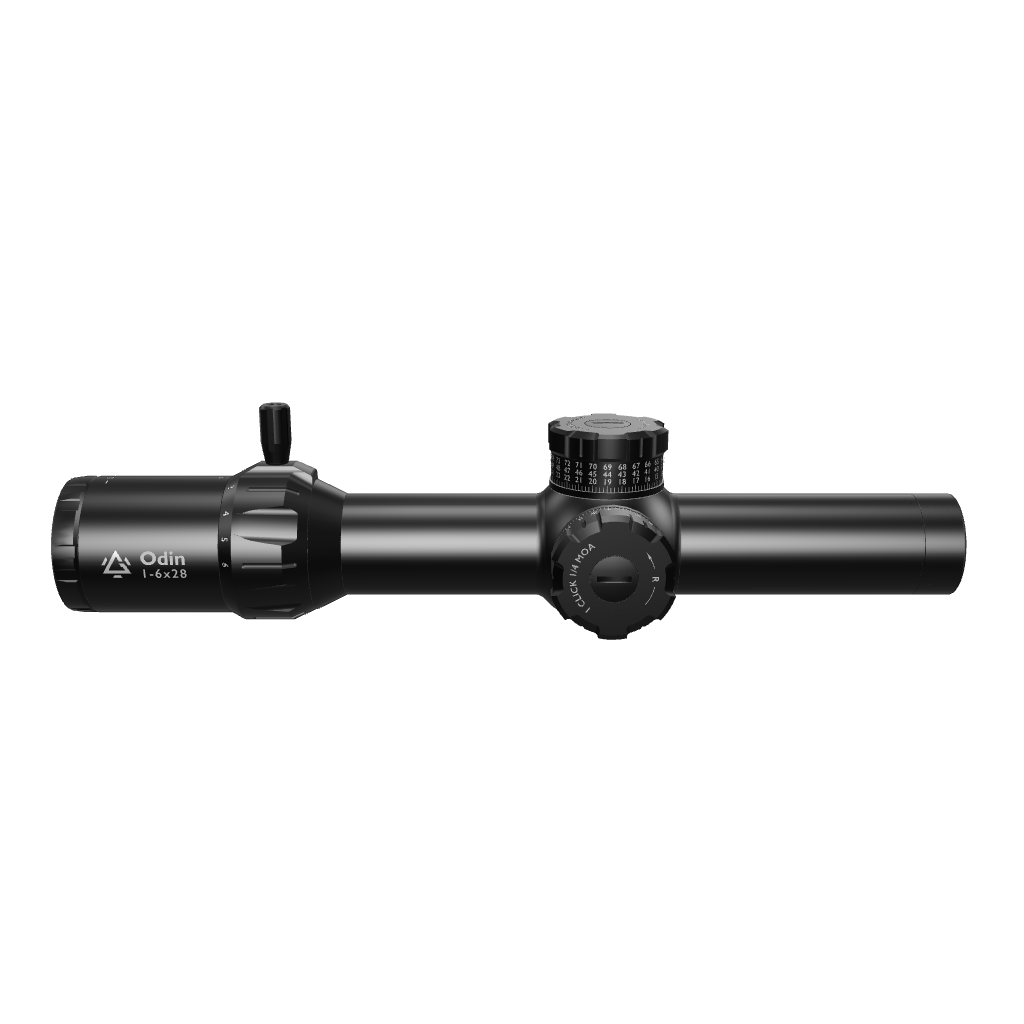

How Do Rifle Scopes Work? Complete Beginner’s Guide

At long distances, the human eye struggles to clearly distinguish targets, as details become smaller and less defined the farther away they are. This limitation makes accurate shooting increasingly difficult without optical assistance. A rifle scope serves as a crucial tool that bridges the gap between the shooter and the target, bringing distant objects into sharp focus. Understanding how rifle scopes work is the first step toward mastering their use and making more effective, confident shots.
What Is a Riflescope?

A riflescope is an optical device mounted on a firearm that is designed to magnify distant targets and provide a clear, precise aiming point. By enhancing both visibility and accuracy, it allows shooters to engage targets that would be difficult—or even impossible—to hit with the naked eye or standard iron sights alone. Riflescopes are widely used in hunting, sport shooting, and tactical scenarios, where precision is critical.
At its core, a riflescope consists of two main components: the lens system and the reticle. The lens system is responsible for gathering light, magnifying the image, and delivering a sharp, focused view to the shooter’s eye. It typically includes an objective lens (at the front), internal lenses for magnification and image correction, and an ocular lens (near the eye).
The reticle, often referred to as the crosshair, is the aiming reference displayed within the scope. Positioned inside the optical system, it remains aligned with the firearm and allows the shooter to accurately place shots on target. Modern reticles can range from simple crosshairs to more advanced designs with markings that help compensate for bullet drop, wind drift, and distance. Together, the lens system and reticle form a complete aiming solution that significantly enhances shooting performance.
Core Structure of a Riflescope

A riflescope is a carefully engineered optical system made up of multiple internal components, all aligned within a cylindrical tube (often called the scope tube). Each part plays a specific role in delivering a clear, correctly oriented, and magnified image to the shooter. Understanding these core elements helps explain how a riflescope produces such precise visual results.
Objective Lens
Located at the front of the scope, the objective lens is responsible for gathering light from the target and forming the initial image. A larger objective lens can collect more light, resulting in a brighter image—especially in low-light conditions such as dawn or dusk. It also plays a key role in determining the scope’s field of view and overall image clarity.
Erector Lens (Image Reversal System)
After light passes through the objective lens, it enters the erector system, a set of internal lenses that correct the image orientation. Without this system, the image would appear upside down and reversed. The erector assembly flips the image into its proper upright position and is also typically connected to the scope’s adjustment turrets, allowing the shooter to fine-tune windage (left/right) and elevation (up/down).
Magnifying Lens System
Within the erector assembly or as a separate group, the magnifying lenses control the level of zoom. In variable-power scopes, these lenses can move relative to each other, allowing the shooter to increase or decrease magnification depending on the situation. This flexibility is especially useful when switching between close-range and long-range targets.
Ocular Lens (Eyepiece)
Positioned at the rear of the scope, the ocular lens delivers the final image to the shooter’s eye. It also allows for diopter adjustment, enabling users to fine-tune the focus based on their individual eyesight. A properly adjusted ocular lens ensures that the reticle appears sharp and clear, which is essential for accurate aiming.
Internal Layout Within the Scope Tube
All these components are housed in a straight, sealed tube that maintains precise optical alignment. From front to back, the typical arrangement is: objective lens → erector system (including magnification components) → reticle (depending on design, either in front of or behind the erector system) → ocular lens. This linear configuration ensures that light travels efficiently through the system, producing a bright, correctly oriented, and magnified image for the shooter.
How Do Rifle Scopes Work
The operation of a riflescope is based on a precise optical process in which light travels through multiple lenses, is manipulated, and ultimately delivered to the shooter’s eye as a clear, magnified image. Each step in this process contributes to accuracy and visual clarity.
Light Enters the Objective Lens and Is Focused
When aiming at a target, light reflected from that target enters the scope through the objective lens at the front. This lens gathers and concentrates the incoming light, bending it to form a focused image inside the scope. The quality and size of the objective lens directly affect brightness and image detail.
The Image Forms and Is Corrected (Erected)
The focused image initially forms upside down due to the way light passes through the lens. It then moves into the erector system, where a set of internal lenses flips the image into the correct upright orientation. At this stage, the image is also aligned with the reticle, ensuring that the aiming point corresponds accurately to the target.
Magnification Is Adjusted
Next, the image passes through the magnification system. In variable-power scopes, this involves movable lenses that allow the shooter to adjust the zoom level. Increasing magnification makes the target appear closer and larger, while decreasing it provides a wider field of view for better situational awareness. This step gives the shooter flexibility depending on distance and shooting conditions.
The Ocular Lens Presents the Final Image
Finally, the processed image reaches the ocular lens at the rear of the scope. This lens refines the image and projects it into the shooter’s eye, ensuring it appears sharp and properly focused. With the reticle clearly visible and aligned with the target, the shooter can make precise aiming adjustments and take an accurate shot.
Types of Magnification
Magnification is one of the most important features of a riflescope, as it determines how large and close the target appears to the shooter. Different magnification types are designed to suit different shooting scenarios, from fast, close-range targeting to precise long-distance shots. The two main categories are fixed magnification and variable magnification.
Fixed Magnification
A fixed magnification scope provides a single, constant level of zoom—such as 3×, meaning the target appears three times closer than it would to the naked eye. These scopes are known for their simplicity, durability, and reliability. With fewer მოძრating parts inside, they tend to be more robust and often maintain better optical clarity and light transmission. Fixed scopes are also typically lighter and more affordable, making them a solid choice for beginners or for applications where shooting distances remain consistent.
However, the main limitation is the lack of flexibility. Since the magnification cannot be adjusted, the shooter must rely on one set zoom level for all situations, which may not be ideal when switching between close and long-range targets.
Variable Magnification
Variable magnification scopes allow the shooter to adjust the zoom level within a specific range—for example, from 3× up to 9×. This versatility makes them extremely popular, as they can adapt to different environments and shooting distances. At lower magnification, the shooter benefits from a wider field of view and quicker target acquisition, while higher magnification provides greater detail and precision for distant targets.
These scopes use an internal system of adjustable lenses to smoothly change magnification, typically controlled by a zoom ring on the scope body. While they offer greater flexibility, variable scopes are generally more complex in design and may be slightly heavier and more expensive than fixed options.
Reticle Types and Functions
The reticle—commonly known as the crosshair—is the aiming reference inside a riflescope. While it may appear simple at first glance, modern reticles are designed with advanced features that help shooters improve accuracy, estimate distance, and compensate for environmental factors such as bullet drop and wind drift.
Common Reticle Types
Duplex Reticle
One of the most traditional and widely used designs, the duplex reticle features thick outer lines that taper into fine crosshairs at the center. This design allows for quick target acquisition while maintaining a precise aiming point. It is especially popular for hunting and general-purpose shooting.
Mil-Dot Reticle
The mil-dot reticle includes a series of evenly spaced dots along the crosshair lines. These dots represent specific angular measurements (milliradians), which can be used for range estimation and holdover corrections. It is commonly used in tactical and long-range shooting due to its versatility and precision.
BDC (Bullet Drop Compensation) Reticle
A BDC reticle features multiple aiming points or hash marks below the center crosshair, each corresponding to a specific distance. These markings are calibrated to account for bullet drop over range, allowing shooters to aim directly at targets without manually adjusting the scope turrets. BDC reticles are especially useful for quick shooting at varying distances.
First Focal Plane (FFP) vs. Second Focal Plane (SFP)
First Focal Plane (FFP)
In an FFP scope, the reticle is placed in front of the magnification system. As a result, the reticle appears to change size when the magnification is adjusted—growing larger at higher magnification and smaller at lower magnification. The key advantage is that the reticle’s measurements (such as mil-dots or hash marks) remain accurate at all magnification levels, making it ideal for precise ranging and holdovers.
Second Focal Plane (SFP)
In an SFP scope, the reticle is positioned behind the magnification system. This means the reticle size stays constant regardless of zoom level. However, the measurement markings are only accurate at a specific magnification (usually the highest setting). SFP scopes are often preferred for their consistent reticle appearance and are commonly used in hunting and general shooting.
Functions
Beyond simply aiming at a target, reticles serve important functional roles. Using known measurements (such as mil-dots), shooters can estimate the distance to a target by comparing its size to the reticle markings. Additionally, reticles with holdover points allow shooters to compensate for bullet drop and wind drift without adjusting the turrets, enabling faster and more efficient shooting in dynamic conditions.
Adjustment and Zeroing
For a riflescope to deliver accurate results, it must be properly adjusted and zeroed. Zeroing is the process of aligning the scope’s reticle with the firearm’s point of impact at a specific distance, ensuring that where you aim is where the bullet lands. This calibration is essential before any serious shooting, especially for precision or long-range applications.
Windage and Elevation Adjustments
Riflescopes are equipped with two primary adjustment controls, usually in the form of turrets:
Windage (Left/Right Adjustment)
The windage turret, typically located on the side of the scope, adjusts the horizontal alignment of the reticle. It allows the shooter to correct for shots that land left or right of the target, whether due to crosswinds or slight misalignment.
Elevation (Up/Down Adjustment)
The elevation turret, usually positioned on the top of the scope, controls the vertical alignment. It is used to compensate for bullet drop over distance, raising or lowering the point of aim so that the bullet strikes the intended target.
Each adjustment is made in small, precise increments (often measured in MOA or mils), allowing for fine-tuning based on shooting conditions and distance.
Using Adjustment Markings for Long-Range Shooting
Most scopes feature clearly marked turrets with click values that correspond to specific changes in point of impact. These markings allow shooters to “dial in” corrections for longer distances rather than relying solely on visual estimation. For example, as distance increases and bullet drop becomes more significant, the shooter can adjust the elevation turret upward to compensate.
In addition to turret adjustments, many shooters also use reticle markings (such as mil-dots or hash marks) in combination with turret settings to make quick corrections in the field. This combination of mechanical adjustment and visual reference provides greater flexibility and precision, especially in dynamic or long-range shooting scenarios.
FAQ
What does 3 9x40 mean on a rifle scope?
A rifle scope marked “3–9×40” indicates that it has a variable magnification range from 3× to 9× and a 40 mm objective lens; this means you can adjust the zoom so the target appears three to nine times closer depending on your needs—lower magnification for a wider field of view and quicker target acquisition, and higher magnification for better detail at longer distances—while the 40 mm front lens gathers enough light to provide a clear, bright image without making the scope overly heavy or bulky, making this configuration a popular all-around choice for hunting and general shooting.
What does 24x50 mean on a scope?
A scope marked “24×50” means it has a fixed magnification of 24× and a 50 mm objective lens; unlike variable scopes, the magnification is not adjustable, so the target always appears 24 times closer than with the naked eye, making it ideal for long-range precision shooting where maximum detail is needed, while the larger 50 mm front lens allows more light to enter the scope, producing a brighter image—especially helpful at high magnification—though it typically results in a heavier and bulkier scope compared to smaller models.
What magnification for a 1000 yard shot?
For a 1,000-yard shot, most shooters typically use a magnification in the range of 10× to 25×, depending on conditions and personal preference; while it might seem that maximum magnification (like 24× or higher) is always best, too much zoom can reduce field of view, amplify mirage (heat distortion), and make the image less stable, so many experienced long-range shooters settle around 12× to 18× for a balance of clarity, target visibility, and stability, increasing magnification only when conditions are calm and visibility is excellent.
Do I pull out the dial on the scope to sight it in?
No—you generally do not pull out the dial on a rifle scope to sight it in. Most scopes use turrets (the adjustment knobs) for zeroing, and these are designed to be turned, not pulled.
To sight in, you simply rotate the elevation (top turret) and windage (side turret) in small “clicks” to move your point of impact up/down or left/right until it matches your point of aim. Each click corresponds to a precise adjustment (such as ¼ MOA or 0.1 mil).
Some scopes do have pull-up or lockable turrets, but in those cases, pulling the dial is only to unlock it before making adjustments or to reset the zero stop after sighting in—not a standard step for every scope. If your turret doesn’t visibly lift or click into a different position, you should assume it’s meant to stay in place and just be turned.
Should I sight my rifle at 50 or 100 yards?
If you’re shooting mostly at longer ranges or want a universal zero, go with 100 yards; if your focus is short-range shooting or smaller calibers like .22 LR, 50 yards can be more practical.
Why do snipers avoid headshots?
Snipers don’t universally avoid headshots, but they often prefer center‑mass (torso) shots because they offer a much higher probability of a hit under real-world conditions. The torso is a larger, more stable target, while the head is small and moves unpredictably—especially at long distances where factors like wind, breathing, and even slight trigger movement can shift the point of impact.
Another key factor is ballistics: over long ranges, bullet drop and environmental effects make precision more difficult, so aiming at a larger target area increases reliability. A solid hit to the torso is also highly effective at immediately incapacitating a target, making it the more practical choice in most situations.