
LPVO With M4A1: Why It Works

The M4A1 carbine is the gold standard for versatility and flexibility, and one of the reasons many shooters love it is that it is highly customizable. This is why, though it’s not the usual choice, picking a proper Low Power Variable Optic as an optic for the M4A1 could actually maximize its performance in many ways.
Many shooters struggle with the classic choice: do we choose speed, or up close? Or do we choose precision at a distance? Pairing an M4A1 LPVO solves this problem by giving you the best of both worlds. This turns a standard carbine into a true multi-range tool that dominates across various engagement scenarios.

Why LPVOs Belong on an M4A1
The M4A1 platform usually goes with your standard 14.5-inch or 16-inch barrel, and is capable of engaging targets out to 500 yards or more. However, a non-magnified optic like a red dot or holographic sight can limit your ability to identify distant threats and shoot accurately past 200 yards. This is where a Low Power Variable Optic (LPVO) steps in.
We know that LPVOs are designed to operate at true 1x magnification, and it gives you the same unmagnified sight picture as a red dot for close-quarters battle (CQB). With a simple flick of a lever, you can transition instantly to 6x, 8x, or even 10x magnification, and this immediate shift means you never have to compromise.
What you get is the CQC speed you need, alongside the precision required for medium to extended ranges. If you want to maximize your rifle’s effective range without sacrificing close-in speed, integrating an LPVO on an M4A1 might be an interesting idea to consider.
Why the M4A1 LPVO Is a Powerful Combo
The combination of the M4A1’s reliability and the LPVO’s versatility creates a rifle system that offers you very high levels of customization and tweaking. This build mainly addresses the hassle of fast transitions between extreme close range and long distances. Let’s check out the advantages and disadvantages.
Pros of the M4A1 with LPVO:
- Versatility: On 1x power, the optic functions like a red dot for close engagements. Once you zoom in, it gives you the magnification for shot placement and holdover correction at over 300 yards.
- Precision and Target ID: Magnification allows you to see smaller targets during coyote hunting, distinguish between threats and non-threats, and easily identify obscured targets at greater distances, which is something you can barely achieve with non-magnified optics.
- Trajectory Correction: Most quality LPVO reticles feature BDC (Bullet Drop Compensator) or holdover marks that provide quick, accurate elevation and windage corrections. It’s tuned to the 5.56 NATO caliber that’s commonly used in the M4A1.
- Durability: LPVOs are built like traditional rifle scopes and are designed to withstand heavy recoil and harsh environmental abuse in comparison to flimsy, budget-value red dots.

Cons of the M4A1 LPVO usage:
- Weight and Bulk: An LPVO and its bulky mount are significantly heavier than a red dot sight. This added weight can affect the rifle's balance and increase your fatigue, especially during extended hunting treks.
- Eye Box and Eye Relief: Unlike a red dot, an LPVO requires proper eye relief and alignment at higher magnifications. If your head position is slightly off, you will lose your sight picture. This can complicate your follow-up shots compared to the forgiving nature of a simple red dot.
- Daylight Brightness: While many high-quality LPVOs have daylight-bright illumination, some lower-end models do not. This makes the reticle difficult to see against bright backgrounds on 1x power and is not ideal for most shooters.
What Features You Should Look for When Choosing an LPVO for an M4A1
Before you proceed with combining an LM4A1 with an LPVO, there are many important points to consider when listing your requirements. Focus on these key features to maximize your investment and capability:
i. True 1x Magnification
This is non-negotiable. What you’re looking for is an optic that has to offer an undistorted 1x view for close-quarter shooting. Without a true 1x, you lose the advantage of a red dot.
ii. First Focal Plane (FFP) vs. Second Focal Plane (SFP)
For first focal plane optics, the reticle scales with the magnification, which means your holdover marks (for windage and elevation) are accurate at every magnification setting.
FFP is often preferred for precision long-range M4A1 LPVO usage. On SFP optics, the reticle stays the same size regardless of magnification. Holdover marks are only accurate at the highest magnification setting, and they usually offer a brighter reticle at 1x.
iii. Glass Clarity and Light Transmission
Make sure you look for scopes with extra-low dispersion glass (also known as ED) and advanced fully multi-coated lenses. This type of glass offers you a very sharp and bright image with almost no chromatic aberration, but they tend to cost a bit more.
iv. Illumination
The reticle must be daylight-bright on 1x power to function effectively as a red dot. Check for multiple brightness settings and settings suitable for night vision compatibility, but only if you frequently hunt at night.
v. Durability and Construction
One of the best optics you can find that gives you value for every dollar is the ones with a 7075 aluminum alloy body and robust ingress protection (IP) rating, like IP67. These important features ensure the scope can handle the shock of firing, resist dust, and resist water damage in heavy weather conditions. Zero stop and locking turrets are also convenient features, but they might not be very cost-effective.

LPVO vs Red Dot and Magnifier on an M4A1
The LPVO system directly competes with the traditional red dot sight with a separate 3x or 5x side-flip magnifier. Both setups offer both CQB speed and distance capability, but they achieve it in different ways. Here’s a comprehensive table with further info on magnification and precision.
| Feature | LPVO (for example, 1-6x or 1-8x) | Red Dot and Magnifier (for example, Red Dot + 3x Mag) |
| Max Magnification | Variable (6x, 8x, or 10x) | Fixed (Typically 3x or 5x) |
| Speed/Transitions | A simple lever helps you transition between 1x and max power. | Flipping the magnifier to the side changes magnification. |
| Precision at Range | Superior. FFP LPVOs offer BDC reticles that are precise at all ranges and powers. | Not bad. Magnified red dot relies on a simple dot, which makes precise holdovers difficult. |
| Weight/Footprint | Heavier and typically takes up more rail space. | Slightly lighter, but still takes up significant rail space when mounted. |
| Field of View (FOV) | Better, especially at higher magnification due to larger objective lenses. | Smaller FOV through the magnifier. |
| Overall Versatility | High. Better for dedicated long-range shooting with an LPVO on an M4A1. | Medium. Best for shooters prioritizing CQB speed above all else. |
For most shooters, especially those looking for maximum accuracy out to 500 yards, the LPVO provides an excellent optical system.
The clean sight picture, greater magnification range, and purpose-built reticles make LPVOs on M4A1 rifles the preferred choice for tactical, hunting, and competition use where targets may appear at varying distances.
The 2 Best LPVO Options for an M4A1 from Gunnr
Selecting the right magnification range is key to tailoring your M4A1 for its primary use. That’s why Gunnr's Odin series of FFP LPVOs offers excellent clarity and durability to meet the demands of any serious shooter.
1. Gunnr 1-6x LPVO: For General Purpose and CQB
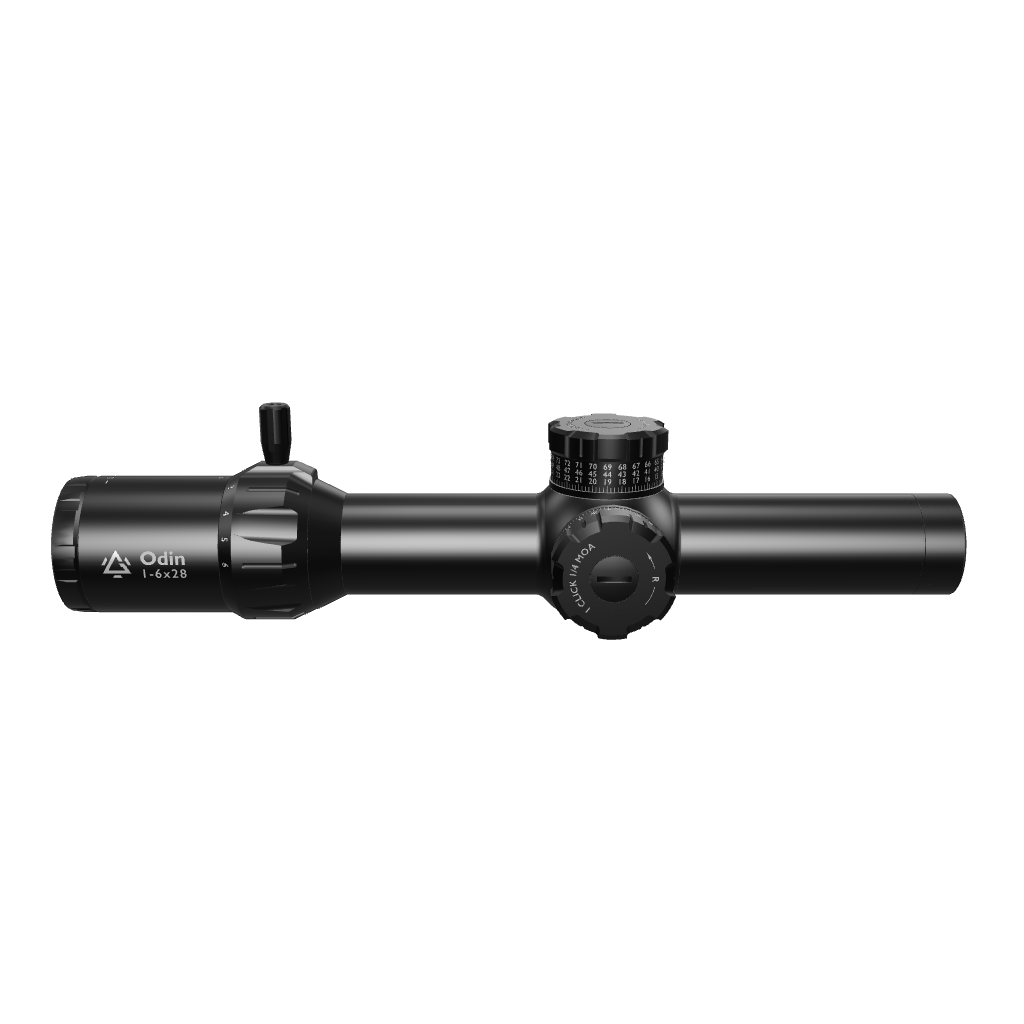
The Gunnr Odin 1-6x28 LPVO is the definitive choice for the shooter whose primary focus is CQB and rapid target engagement at close and mid distances.
- Featuring a wide 34mm tube and an impressive 122.5-yard field of view at 100 yards, this scope offers unmatched situational awareness on 1x.
- Built with German Schott ED Glass, its FFP GRX-2B MOA reticle remains accurate across all six power settings.
- The compact 11.7-inch length and 685g weight balance perfectly on an M4A1, making it a rugged and fast optic suitable for close-range, as well as general-purpose scenarios.
2. Gunnr 1-8x LPVO: For Mid-Range Flexibility
The Gunnr Odin 1-8x24 LPVO offers well-balanced close-in speed and extended reach. It is the ideal middle ground for shooters who regularly engage targets in the 300 to 500-yard range.
- This optic features the same core benefits-German Schott ED Glass, FFP reticle, Zero Stop, and IP67 protection-but offers that crucial 8x magnification for better observation and precise bullet drop compensation.
- At 11.1 inches and a light 666g, the LPVOs on an M4A1 platform like this 1-8x model maintain excellent maneuverability and effective range.
Common Mistakes Shooters Make When Pairing an LPVO With an M4A1
For the best performance for LPVO shooting, avoid these common setup and technique errors:
- Improper Mounting: Many shooters make the mistake of mounting the LPVO too low, and this gives you a very awkward chin weld instead of a proper cheek weld. An AR-specific scope mount or cantilever mount with a proper centerline height (usually 1.5 inches above the rail) is essential for a consistent sight picture on 1x.
- Zero Stop: Failing to set the zero stop means you cannot dial elevation corrections and return quickly to your original zero setting. As a best practice, always set the zero stop immediately after zeroing your rifle.
- Treating the 1x Like a Red Dot: While the 1x mag is fast, it is not infinitely forgiving like a red dot. You must maintain good eye alignment and head position to quickly pick up the reticle. It’s a good idea to practice your shooting with both eyes open at 1x to build speed and avoid the tunnel vision effect.
- Overcomplicating the Reticle: Choosing a reticle with too many features that you never use can clutter the sight picture and just make the job more difficult for you.

Should You Run an LPVO on Your M4A1?
We hope that this guide will help you choose a proper combo for your LPVO build. Here’s what to do if you’re feeling confused or are having second thoughts about installing an M4A1 with an LPVO.
You need an LPVO if:
- You want to reliably engage targets from contact distance out to 300 yards or more.
- You actively go to shooting competitions with variable distance stages.
- You need better target ID and assessment at long ranges.
- You prioritize accuracy and the ability to utilize holdover marks for wind and drop.
You do not need an LPVO if:
- You use your rifle for home defense or CQB at under 50 yards.
- Budget is your absolute main concern.
- You prefer the speed and forgiving eye box of a traditional red dot sight.
Ultimately, the LPVO can transform the M4A1 from a close-range fighter into a versatile, high-precision weapon. If you’re looking for maximum capability from your carbine, investing in a quality M4A1 LPVO setup is undeniably a top choice.
Consider our thoughts on LPVOs for .22LR rifles and more useful blogs from Gunnr.