
Deer Hunting Rifle Scopes Explained

When it comes to deer hunting, having an appropriate hunting rifle is crucial, but much of your success is determined by what kind of rifle scope you are using. In deer hunting, especially, the difference between spotting a buck at first light and missing it entirely, or placing a clean, ethical shot versus guessing at distance and hold mostly comes down to how good your scope is, and how suitable it is in the particular scenario.
Magnification alone does not make a good deer hunting scope: it is about clarity in low light, quick target acquisition, and reliability when it counts. And if you don’t understand what makes a scope fit your hunting style, it’s easy to overspend on the wrong thing, or worse, under-scope your rifle and run into problems out there in the field.

4 Best Types of Rifle Scopes for Deer Hunting
A lot of people try to look for the “best scope for deer hunting,” but there is no single rifle scope that is always the best for deer hunting all the time, in every scenario. In practice, different hunting situations call for different optics. Here are the main types you’ll realistically consider.
1. Low Power Variable Optics (LPVO) (1–4x, 1–6x, 1–8x)
The big advantage of using an LPVO for deer hunting is that these optics are incredibly versatile. They give you the adaptability if you need to adjust your shooting range or match the speed of fast-moving deer.
At 1x, an LPVO acts almost like a red dot for fast shots. Then, in a quick, smooth turn of a dial, you can dial up the magnification and get enough zoom for mid-range shots. That variability in magnification range, from 1x to about 8x and even 10x, is what makes them great for deer hunting.
Consider an LPVO if you hunt in woods or thick brush, or want a scope that does a bit of everything. They pair really well with lightweight bolt-action rifles and semi-auto hunting rifles.
2. Traditional Hunting Scopes (3–9x, 2–10x)
A traditional hunting scope is the classic deer hunting setup for a reason. It balances magnification, simplicity, and reliability. Usually, a good hunting scope can reach up to 50–300 yards, and it gives speed and adaptability in mixed terrain. It is great for general-purpose deer hunting and best paired with a bolt-action hunting rifle (actually one of the most common deer setups).
These scopes are used by beginners and experienced hunters alike, but they are really beginner-friendly. Perfect if you want a proven, no-nonsense option.
3. High Power Variable Optics (HPVO) (4–16x, 5–20x)
An HPVO works for deer hunting because the higher magnification helps with precise shot placement at longer distances. A good HPVO can make a real difference if you are deer hunting in an open field, or in western hunting situations where you need to make long-range shots (200+ yards)
It works best with precision bolt-action rifles and heavier hunting setups. Consider an HPVO if you hunt in open country or are just comfortable taking longer shots.
4. Fixed Power Scopes (4x, 6x)
Fixed power scopes are simple, durable, and often very clear. They are ideal for deer hunting when you are already pretty familiar with the terrain and have a clear understanding of what you need from the scope. From a maintenance perspective, fixed scopes give you a bit of an edge: since they have fewer parts, there is a lower chance of damage, and they are quite easy to set up.
A fixed scope is great if you consistently hunt deer in the same area, or if you are a traditionalist who prefers a simple scope. They go great with hunting rifles.

Choosing the Right Rifle Scope for Deer Hunting
The objective, when choosing a deer hunting scope, should always be to find a scope that lets you see clearly in low light, acquire targets quickly, and make confident, ethical shots. The right scope should match how and where you hunt, not just what looks impressive on paper.
1. Magnification Range.
If you are hunting in the woods, you need lower magnification (1–6x). Go for a fixed scope or LPVO depending on how much magnification you need (or if you need it at all). In open land, choose an optic with higher magnification (3–15x+). Here, you can go for a higher magnification fixed scope, or a 1-8x+ LPVO. Again, it depends on how much magnification you need.
Explore a complete scope magnification chart.
2. Objective Lens Size (Light Gathering)
Objective lens size is especially important in a deer hunting rifle scope. 40–44mm is a sweet spot for most deer hunters. In deer hunting, having a scope with a larger objective lens helps in low light. This is a very important consideration to make since deer hunting mostly happens at dawn or later at dusk.
3. Check the Reticle Type
Hunters use scopes with different types of reticles, but most deer hunters prefer optics with simple duplex reticles because they are fast and clean. However, these are often limited in long-range shooting. For deer hunting in open spaces where you need to dial up the magnification, go for an optic with a BDC reticle. These are helpful for longer shots.
4. Ensure Proper Low-Light Performance
Low-light performance is a crucial feature for a deer hunting scope. Again, deer move most at dawn and dusk. Irrespective of what kind of optic you go for, make sure it has exceptional glass quality. Having the skillset and experience to shoot in low light, but the scope plays a huge role.
5. Consider its Weight and Size
A heavy scope can throw off your rifle balance, especially on long hunts. For deer hunting, you typically do not use a fixed setup; you have to carry the rifle, with the scope and accessories around. A lightweight LPVO is always a good idea, but you must ensure it has all the features you need.
6. Durability
You want something waterproof, fog-proof, and shock-resistant. Most deer scopes take a beating, mainly because they are used in rugged environments. The more durable it is, the longer it will serve you.
Deer Hunting Scope Recommendations by Hunting Scenario
| Hunting Scenario | Recommended Scope Type | Why It Works |
| Dense woods/brush | LPVO (1–4x or 1–6x) | Fast target acquisition, wide field of view |
| Mixed terrain | 3–9x traditional scope | Versatile and balanced |
| Open fields/farmland | 3–12x or 4–16x | Better for longer shots |
| Mountain / long-range hunting | HPVO (4–16x or higher) | Precision at distance |
| Short-range, fast action | Fixed 4x or LPVO | Simple and quick |
LPVO vs HPVO for Deer Hunting
1. LPVO (Low Power Variable Optic)
An LPVO is best for deer hunting where you need to take close to mid-range shots (under 200 yards), and the deer is likely to appear quickly and unpredictably. If you are hunting in thick cover, an LPVO is also great.
They are extremely fast to use, provide a wide field of view, and are flexible for changing distances. If this reflects the situation in which you hunt regularly, then go for an LPVO.
For deer hunting with an LPVO, you want a 1–6x or 1–8x LPVO, with bright, clear glass for low-light performance. Ensure it has a simple reticle for fast aiming and is lightweight and durable.
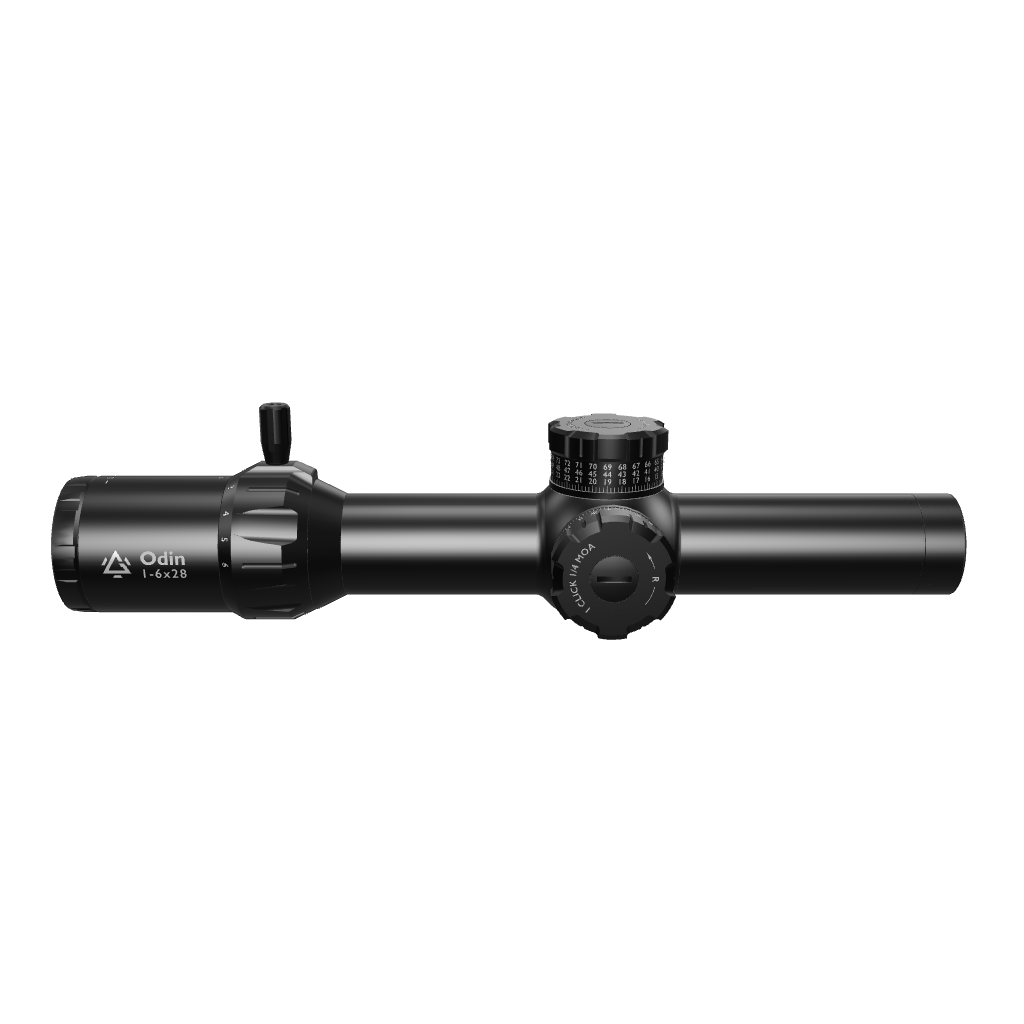
Odin ED 1-6×28 FFP LPVO: Durable, Clear LPVO For Deer Hunting
Gunnr Odin 1-6x28 LPVO offers you the perfect blend of innovation and reliability at a price that won't break the bank. It features the superior clarity of German Schott ED Glass for edge-to-edge sharpness for every shot.
With a first focal plane (FFP) reticle that provides fast, you get accurate distance estimation at any magnification, adapting seamlessly to changing light conditions with six brightness settings. Constructed from durable 7075 aluminum alloy, this scope is IP67-rated for dust and waterproof performance, guaranteeing dependability in any environment.
With the Gunnr Odin, you're equipped with a versatile tool designed to enhance your shooting experience and leave you wondering how you ever aimed without it.
2. HPVO (High Power Variable Optic)
An HPVO is good for deer hunting when you are hunting in open terrain, and you need precise shot placement for longer and more deliberate shots.
HPVOs provide greater detail at a distance, and work best when you need to identify targets from far away.
For deer hunting with an LPVO, the objective should be to find a 3–15x or 4–16x magnification with excellent clarity at higher zoom. It must have reliable tracking and adjustments, and a solid low-light performance despite higher magnification.
Gunnr's Heimdall HD 6-24x50 HPVO scopes are built for long-range shooting, specifically over 1,000 yards. With key features like precise FFP reticles, 6-24x magnification, 20 MOA windage/elevation adjustment, and German Schott lenses, these HPVOs focus on tracking accuracy, practical reticles, and solid construction rather than unnecessary features.
If you are serious about stretching past 1,000 yards, the HEIMDALL HD HPVO provides the performance and confidence that many high-quality scopes simply cannot match.
Final Thoughts on Deer Hunting Rifle Scopes
A good deer hunting scope doesn’t need to be complicated; it just needs to match your hunting style. If you’re in thick woods, speed matters more than zoom. If you’re in open country, clarity and precision take over.
Get that match right, and your scope stops being just an accessory; it becomes one of the most important tools you carry into the field. Explore the best calibers for deer hunting, and how to choose based on your shooting needs.